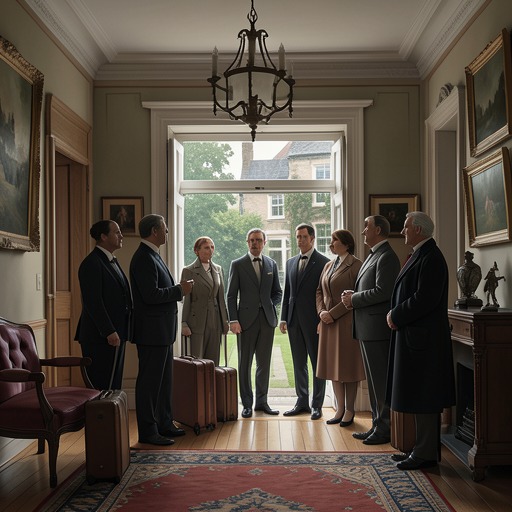
Marquis de Cambremer
In Search of Lost TimeThe Marquis de Cambremer is a Norman aristocrat whose title carries weight in drawing-room etiquette even as his appearance, conversational habits, and provincial ease frustrate other people’s expectations of a great gentleman. At La Raspelière, which he and his family have leased to the Verdurins, he returns as both landlord and guest, and his presence brings social rank into collision with personal manners. Later, estranged from the Verdurins, he continues to invite the narrator to his family’s home at Féterne, where hospitality, illness, and local sociability become inseparable.
Identity and Background
The Marquis is the son of the older Marquise de Cambremer, who affectionately observes that he takes entirely after his father. That family resemblance is also a social contrast: the narrator finds him unlike the old Marquise and describes his face as dominated by an unusually crooked, prominent nose, heavy and drooping eyelids, and a high Norman complexion. The narrator reads these features as signs of vulgarity and limited intelligence; the nose seems to look in place of the eyes. This judgment is not presented as an objective measure of the Marquis’s character so much as a clash between observers’ standards: a judge’s wife considers him a man of supreme distinction and perfect breeding, while the narrator imagines that his grandmother would have called him common.
The narrator allows a more accommodating interpretation of the Marquis’s face. Its irregularities seem to carry something anciently local, like the mispronounced place-names of Normandy whose distorted forms have become established over generations. The comparison places the Marquis within the region rather than simply outside refinement: his imperfect features, like local names, register the persistence of a provincial history. The old Marquise herself often called him the best of her family, despite having other children who were not without merit.
During his brief period of military service, his fellow officers found the name Cambremer too long and called him Cancan, a nickname suggesting gossip that the narrator says he had done nothing to deserve. The name nonetheless suits his ease at dinner parties, where he could brighten the table by admiring a fish or entrée, even if it was putrescent, as a fine-looking beast. His conversational charm is not polished wit but a blunt, habitual cheerfulness that makes him memorable.
La Raspelière and Social Rank
The Marquis and his wife are invited to dinner at La Raspelière for the first time by their tenants, the Verdurins. The invitation has a practical purpose: the Verdurins hope to secure better lease terms for the following year. The dinner also exposes the gap between the Marquis’s personal attachment to the estate and his family’s loss of control over it. On returning, he delights in recognising the painted flowers above the doors and the marble busts on their pedestals, telling Madame Verdurin that he is at home again. Yet she has brought in many fine old objects of her own, and the house no longer bears only the appearance he remembers.
The Cambremers regard the Verdurins’ changes as an assault on the old house. In particular, they object to plain cloth curtains in place of their rich plush, while the narrator sees Madame Verdurin not as a revolutionary but as a conservator acting on a different understanding of what the house should be. A herb garden is beginning to displace flower-beds prized by the Cambremers and their gardener. The gardener still regards the family as his masters and secretly carries his grievances to the dispossessed mistress of the house. The estate’s alterations thus turn a lease into a small contest over memory, taste, and authority.
The Marquis’s title is also active in the evening’s choreography. Before he begins speaking to the narrator, his tall figure and ruddy complexion seem to oscillate with the hesitant, reassuring manner of a commanding officer. He shakes the narrator’s hand and says that he believes the narrator knows his mother, then immediately mentions a note from her. When the Marquis arrives, Madame Verdurin and her husband consider how to arrange the honours among him, Baron de Charlus, and Princess Sherbatoff. M. Verdurin reasons that because the Marquis is a marquis, Charlus is lower in rank; Madame Verdurin consequently places Charlus beside the Princess. The seemingly casual arrangement makes hierarchy visible as a practical decision about seating and precedence.
At table, the Marquis appears to offer his chair to Charlus, who is standing. Charlus interprets the gesture as recognition of a duty owed to a prince, then refuses it with emphatic familiarity, insisting that such precedence is reserved in these days for princes of the blood. The encounter leaves the Marquis’s intention uncertain: he may simply mean to be polite, while Charlus turns the offer into an occasion to assert rank. The scene shows how a gesture can acquire a political meaning through the competing interpretations of those who witness it.
Family Manner and Conversation
The Marquis’s ease is frequently comic because it is at once generous and socially unexamined. At dinner, he can make conversation by commenting on the food, and his wife adopts his nickname when speaking to officers, referring casually to Cancan as though sharing the habits of his former bachelor life. Her performance of the family’s ethos contrasts with the narrator’s sense that the Marquis’s own manner is unselfconscious rather than calculated.
He also treats his sister’s health as a ready measure for interpreting other people’s symptoms. When he hears that the narrator has suffered spasms, he responds with satisfaction because the news gives him something to report to his sister. He asks for details in order to compare the narrator’s attacks with hers, and assumes that remedies that work for his sister should be suitable for the narrator. His confidence irritates the narrator, who observes that refraining from imposing a regimen on others can be harder than submitting to one oneself. The exchange makes the Marquis’s concern real but self-centred: another person’s suffering matters to him chiefly as a point of comparison with his sister’s.
Even his laughter at the narrator’s illness is described as lacking deliberate malice. On a later occasion, while urging the narrator to visit Féterne, he shakes with laughter over the narrator’s severe attack and predicts that the next day he will hardly be able to stand. The narrator connects this response to the Marquis’s habit of laughing at a lame man hobbling along the street or when speaking to a deaf person. The repeated pattern gives the Marquis a blunt, insensitive comic quality without making him a schemer: he reacts to visible affliction with an involuntary amusement that others experience as unkind.
Estrangement and Continued Hospitality
By the time of the narrator’s later journeys, the Marquis has become completely estranged from the Verdurins. The rupture does not erase his ties to the narrator. At a railway stop, he comes to see off his own guests and, on behalf of his wife and mother, asks whether the narrator will let him carry him off for a few days at Féterne. He promises that the narrator will be entertained by a woman of great musical talent who will sing all of Gluck and by a famous chess-player, as well as by fishing expeditions and yachting in the bay.
The invitation is generous but carefully connected to the Marquis’s continuing social arrangements. He promises that the visit need not prevent the narrator from attending Verdurin dinners: he will lend the narrator to the group, send him back and fetch him again, both for convenience and to ensure his return. The language makes hospitality sound almost like the management of a guest’s itinerary, while the promise itself shows that the Marquis can continue to mediate between social circles even after his own relationship with the Verdurins has broken down. His offer is also practical in its attention to the narrator’s health, though that concern quickly becomes another opening for discussion of his sister’s spasms.
The Marquis therefore remains legible through contradictions rather than a dramatic transformation. He is a titled landlord whose domestic authority has yielded to the Verdurins’ changes; a man whose precedence is negotiated in public even as his own manners invite conflicting judgments; and a host whose affection for the narrator is expressed through substantial invitations and an awkwardly self-involved interest in illness. His comic portrait reveals how aristocratic rank, local identity, taste, and everyday behaviour can pull in different directions without cancelling one another.